How this saves my life
Originally published in Substack: https://deferocontra258173.substack.com/p/driving-like-a-fish?r=3ouoi0&utm_campaign=post&utm_medium=web&showWelcomeOnShare=true
Here’s the question: when driving a scooter in a busy Asian city, how is it that I can remain calm when my brain is trying to process an insane amount of data all at once?
Now that I’m no longer a trembling vulnerable pedestrian dodging oncoming scooters, I actually feel more relaxed. As a motorbike driver, I’m now in control.
I have agency. I have power. Agency seems to reduce the experience of danger.
But agency is only part of the story. Something else is happening in the way I’m processing all the information around me.
No longer am I a little fish worried about getting eaten by a big fish. I am now a big fish. But not like a big shark. More like a medium-sized creature slipping through the water as a member of a large group of others just like me.
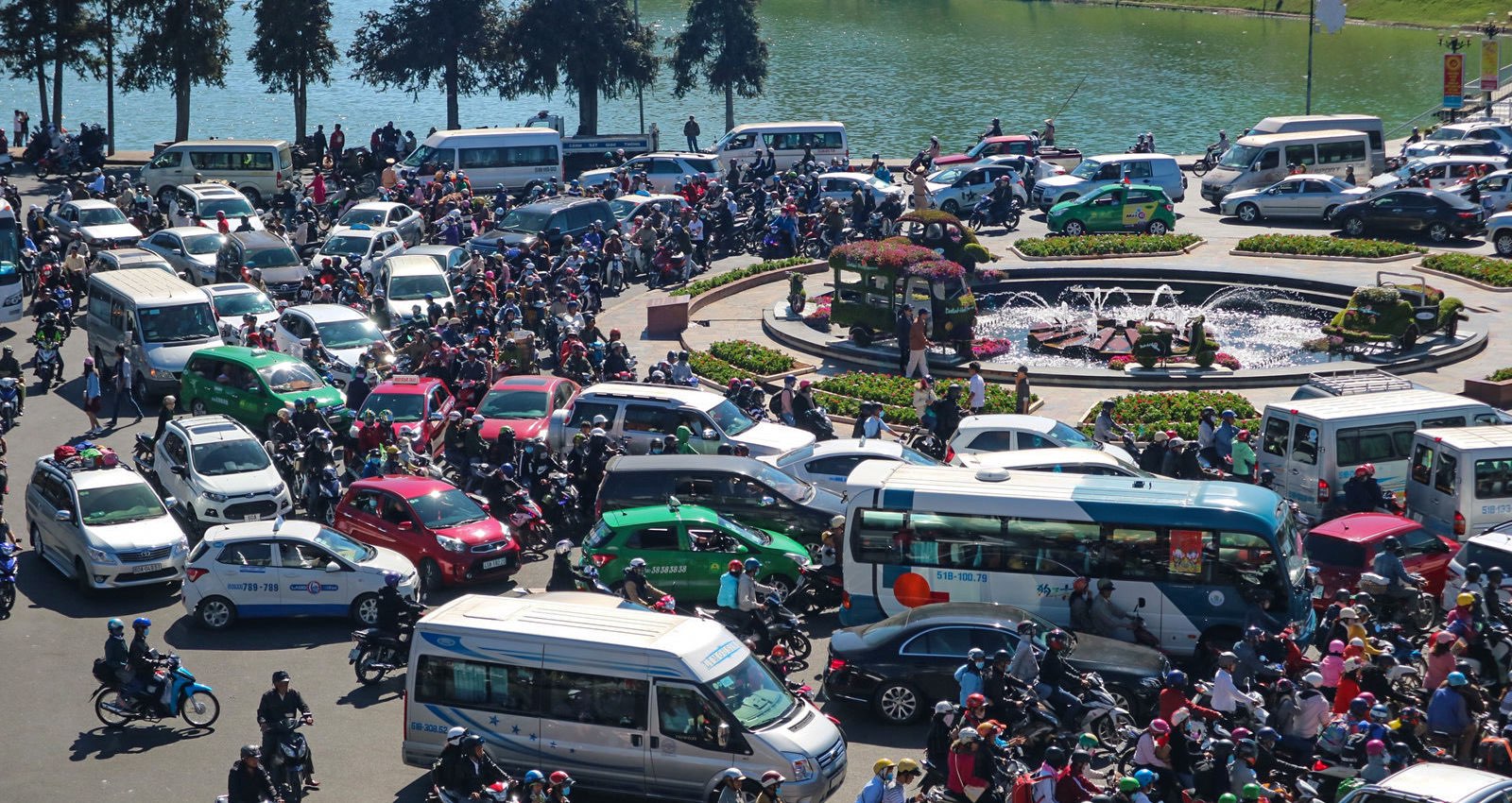
As a new driver fully emersed in the busy traffic of Da Lat, Vietnam, I must now pay attention to far more than oncoming scooters. I must now pay attention to countless other scooters, cars, trucks, buses, pedestrians, traffic signals, direction signs, city landmarks, and my battery powered Google Maps perched on that rattling phone bracket mounted on the handle bars.
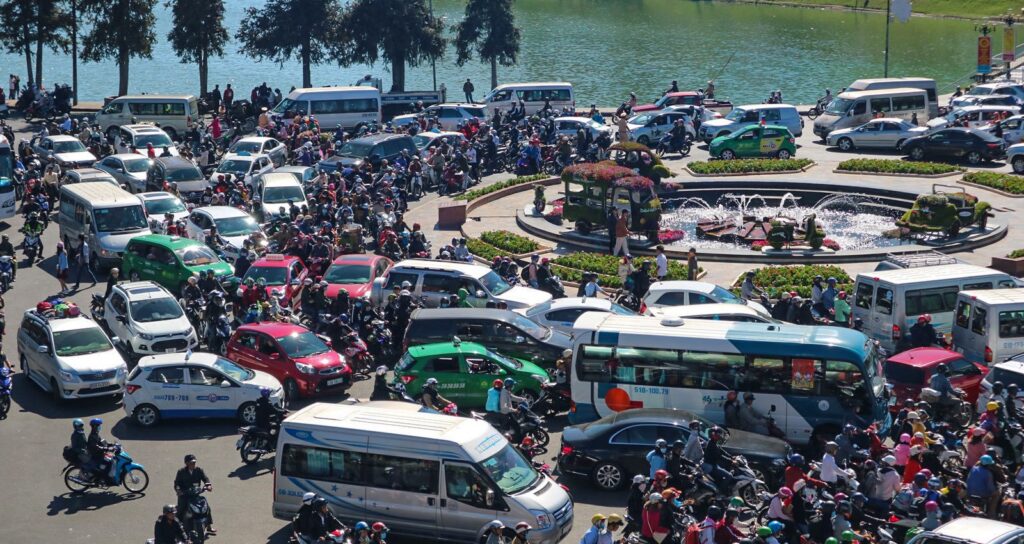
I must now take care to not collide with any other metal machines rolling along beside me or suddenly in front of me. In a way, being out in traffic seems even more dangerous than walking along the road.
It’s just that I actually feel more relaxed and “in the flow.” I feel calm. Yes there are spikes of alarm. It’s just that when the feeling of alarm passes, there seems to be a lower baseline of “nervous system arousal” since I became a driver. Baseline of nervous system arousal? I’m talking about that hyper alert feeling that probably stays with me into the night and robs me of really decent sleep.
How can it be that I feel more calm while having even more things to pay attention to?
How can it be that my brain is not overheating with all the work it must do. It feels as though my brain would have to track the position and velocity of every vehicle around me—and then anticipate where everybody will be two seconds from now. And on top of that, I must make constant course corrections to stay in the clear.
In some moments the flow of traffic seems smooth and more-or-less predictable. In other moments, I notice cross currents where two or more streams of traffic are moving in different directions, crossing each other like the warp and woof of woven fabric.
How can I be surrounded by such an absurd amount of information—and yet feel calm?
There are two angles to look at this. One is the science of how the brain works. The other is how I decide to turn the dial of my awareness to meet the needs of the moment.
Science tells us that the brain conserves energy by treating some things as more important than other things. The brain also converves energy by perceiving relationships and patterns rather than studying multiple isolated objects. Good skills and habits enable the brain to function even more efficiently.
When crudly compared to a computer, the subconscious mind runs in super-fast parallel-processing mode. As the human operator, I’m trying to allow that super-fast parallel-processing mode to run without slowing it down by thinking too much.
How do I do that?
It’s like I turn the dial of my awareness and transform or “shape shift” as though becoming something else. I transform from an individual observer into a responsive participant in a larger pattern. In other words, I stop trying to process the traffic one object at a time.
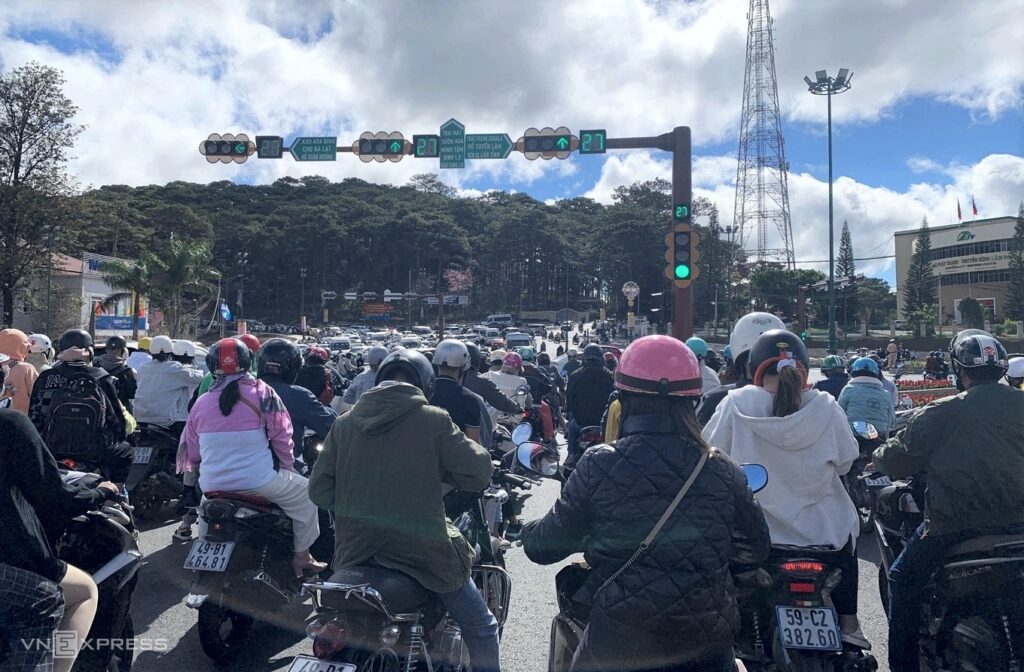
As a metaphor, I transform into a single pixel in a sea of other pixels all moving together in an orderly flow. I become a bird in a flock or a fish in a school of fish.
Countless things are happening on all sides. I pay attention to nearly all of them, yet I consciously think about almost none of them. This provides “space” for relaxation.
Recently, as I was moving along in traffic, I looked at the entire pattern and began to see something even deeper.
Af first, when viewed through my male Western-conditioned eyes, it appeared as thought the countless drivers were competing with each other for space, everybody trying to out maneuver the next guy and get ahead. Let’s call that the competitive model. It’s rough and rugged. You could say I was projecting my personal conditioning onto the outer scene.
Modern psychology understands that projection. We don’t merely perceive reality; we interpret patterns through the mental models we’ve already learned.
So far so good. It’s just that the “competition” model did not feel satisfying to me. It did not feel accurate. What would be more accurate?
Let’s start with the raw observation itself. Here’s what I actually observed. While in busy traffic, traveling at a moderate speed, motorbikes and cars immediatly move forward to fill in the slightest gap or opening.
To a Western observer, this may seem agressive. I don’t think it actually is. Remember, the sense of “personal space” in Asian culture tends to be smaller and closer to the body than in Western culture. I’ve seen this in my travels in India, Cambodia, and now Vietnam.
So if people aren’t competing, what’s actually going on? There’s another way to see the same scene.
I think a good analogy is water trickling down a gentle slope of dry earth. The water seeks to travel this way or that to fill any low points, any depressions, any voids. The water is simply following its nature, its physics.
Vietnamese drivers seem to instinctively move forward to fill the slightest gap. When they see an opening in the traffic pattern ahead, it appears that they take it automatically. The unconscious motive driving this could be more like making the best use of space rather than shaving miliseconds off travel time. It could be like water trickling down the slope.
This could be efficiency and economy and a sign of driving skill more than anything else. These are all just possibilities I dreamed up, not certainties.
I admit it. My own ego does rise up at times, especially when a piercing honk from a truck causes pain. Otherwise, the flow of traffic feels almost pleasant most of the time.
With the understanding I’ve just spelled out, my cute Western ego will have less to object to and should remain calm more of the time. (Time will tell.)
Calm? Now we can circle back to the calm in the face of an ocean of data we talked about earlier. To me, it looks like staying calm is a skill that can be learned and cultivated like a martial art.
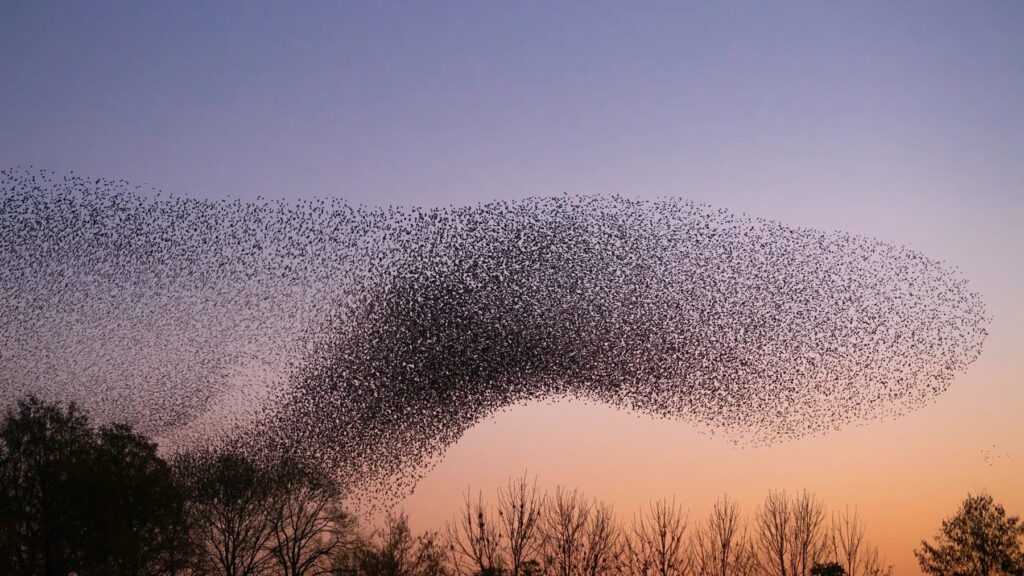
Maybe the trick would be to extend awareness outward in all directions, relax, and respond instantly to changes in the pattern–just like birds in the sky when they are in “flock mode.”
As in the movie Top Gun Maverick, “don’t think, just do.”
That’s trippy.